TLDR
- The asking rate in cricket is the Required Run Rate (RRR): runs still needed ÷ overs remaining, used only in the second innings of limited-overs matches.
- The asking rate in cricket is the Required Run Rate (RRR): runs still needed ÷ overs remaining, used only in the second innings of limited-overs matches.
- It constantly shifts with every ball and, together with current run rate (CRR) and wickets in hand, defines how much pressure the chasing team is under and how aggressive they must be.
- When CRR < RRR, teams are forced into higher-risk batting (more big shots, more chances of losing wickets). Analytics and Dynamic Programming show where this risk threshold lies and when attacking becomes mathematically optimal.
- For betting and predictions, RRR is a key input in Win Probability Models and machine learning tools, which use historical data to estimate a team’s chances from situations like “80 off 10 with 7 wickets left.” Markets often overreact to sudden RRR spikes, creating short-lived value opportunities.
- In modern cricket, RRs of 10.5–12 RPO in T20 are challenging but chaseable; above 13–14 RPO demands near-perfect power-hitting. Understanding how asking rate, pressure, and strategy interact helps VIPJEE users make smarter, more analytical betting decisions.
Welcome to VIPJEE Official: your go-to place for smart cricket predictions and clear, simple analysis to help you make better decisions in online cricket betting. We share practical reviews and insights so you can focus on matches that are both fun to watch and offer better winning chances.
If you really want to understand what’s happening in a limited-overs match, especially during high-pressure tournaments like the IPL and World Cup, you need to know Required Run Rate (RRR), also called the asking rate. It’s not just a random number on the screen though! It’s a key sign of which team has the momentum and how the chase is shaping up. A lot of our strategies are built around reading these numbers properly, so you can spot smarter opportunities and make more informed bets.
What is Asking Rate in Cricket? (RRR)
The term “asking rate” is the common synonym for the statistical measure Required Run Rate (RRR). This metric is exclusive to the second innings of limited-overs matches (like T20s and ODIs), providing the indispensable, real-time tactical objective that the batting side must meet to successfully chase the target and secure victory.
Calculation: Runs Required vs. Overs Remaining
The Required Run Rate is mathematically calculated using a simple quotient that quantifies the pressure on the chasing team:
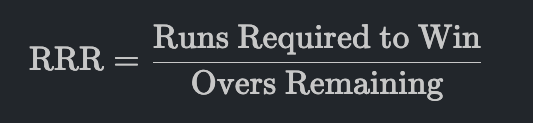
To use this formula properly, you just need two things:
1. Runs required to win
Take the target score (the total set by the team batting first), subtract the runs the chasing team has already scored, then add 1 run (because you have to go past the target to win).
2. Overs remaining
This is the total overs for the innings minus the overs already faced. Overs are often shown in decimals, like 17.3 overs, which means 17 overs and 3 balls. Since there are 6 balls in an over, 17.3 overs = 17 + 3/6 = 17.5 overs.
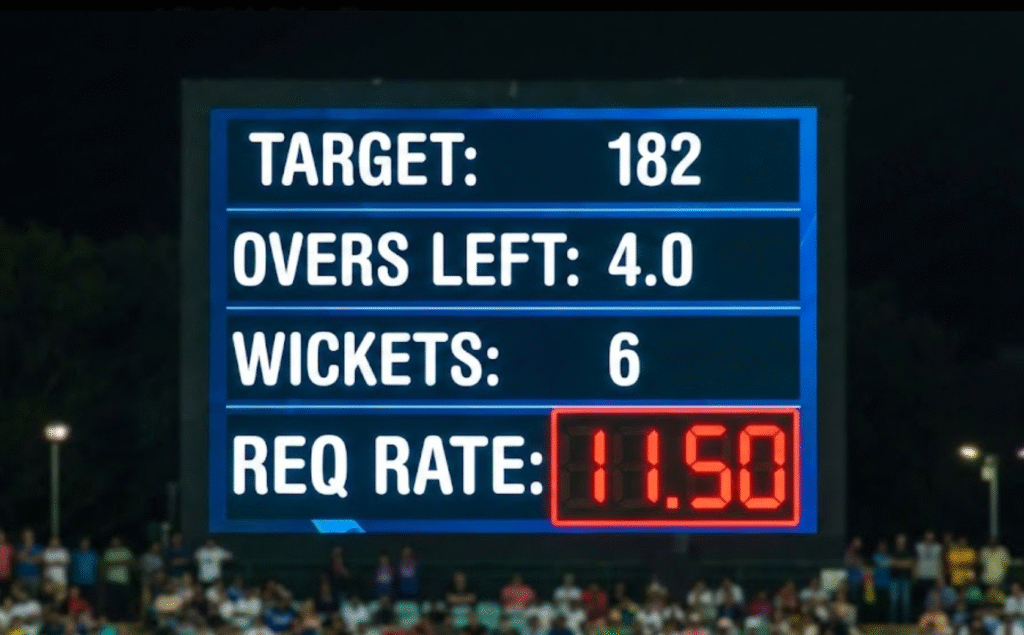
The asking rate (RRR) can change very quickly. One four or six can bring it down sharply, while a few dot balls in a row eat up overs without reducing the runs needed, making the asking rate shoot up. This live, moving number is a key guide for both the batters in the middle and the coaching staff when they’re planning how to chase the target.
The Dynamic Interplay with Current Run Rate (CRR)
The immediate strategic status of the chasing team is defined by the relationship between the RRR and the Current Run Rate (CRR). The CRR is the average number of runs scored per over by the batting side up to that point. It is calculated as the Total Runs Scored divided by the Total Overs Faced So Far.
The strategic standing is determined by the differential rate:
- Positive Margin (CRR} > RRR): The batting team is scoring faster than required, giving them latitude to play cautiously, consolidate wickets, and manage risk.
- Negative Margin (CRR} < RRR): The team is lagging behind and must increase their aggression to prevent the RRR from escalating rapidly.
If the team’s current scoring pace is insufficient, the RRR will paradoxically spiral upward, making the requirement progressively harder to achieve. This metric functions as a critical behavioral governor, quantifying the risk level necessary to fulfill the objective.
RRR vs. Net Run Rate (NRR): What Are the Differences
While often confused, understanding the distinction between the asking rate in cricket (RRR) and the Net Run Rate (NRR) is essential for accurate analysis.
| Metric | Primary Use Context | Function |
| Required Run Rate (RRR) | Real-time objective for the team batting second (chase) | Measures the immediate runs per over needed to win the current match |
| Net Run Rate (NRR) | Tournament tie-breaker calculation | Measures the overall scoring efficiency across all matches in a league |
Net Run Rate (NRR) is the stat used to separate teams that finish on the same number of points in leagues and tournaments like the ICC World Cup, IPL, PSL, or BBL. In simple terms, it compares how quickly a team scores runs with how quickly they give them away.
To calculate NRR, you take:
(total runs scored ÷ total overs faced) minus (total runs conceded ÷ total overs bowled).
If the number is positive, it means your team scores faster than it concedes, which is usually what helps a side finish above another team with the same points.
One important detail: if a team gets bowled out, they are still treated as if they batted the full quota of overs (for example, all 50 overs in an ODI or all 20 overs in a T20) for NRR purposes, even if they didn’t actually face that many.
Rain can also affect NRR. In shortened matches, the adjusted totals given by the Duckworth–Lewis–Stern (DLS) method are used in the calculation, since DLS is designed to set fair targets when overs are lost.
Read more: How Net Run Rate is Calculated in IPL?

How Asking Rate Dictates Batting Performance
The asking rate in cricket puts huge mental and tactical pressure on the batting side, especially in limited-overs games. Chasing teams constantly have to juggle two things:
- scoring fast enough to match the required run rate (RRR)
- protecting their wickets so they don’t collapse before the finish line
Too cautious, and the asking rate shoots up. Too aggressive, and you lose wickets and run out of batters.
Pressure, Wickets in Hand, and Decision-Making
In a run chase, almost every decision comes back to three simple numbers:
- Runs needed (the asking rate / RRR)
- Balls remaining (how much time is left)
- Wickets in hand (how many batters you still have)
As wickets fall, the team’s ability to keep up with a high asking rate drops quickly. Lower-order batters are usually less reliable and often have to attack from ball one, which adds even more risk.
Think of wickets as a safety cushion:
- Strategic buffer: When you have plenty of wickets in hand, you can afford to take chances: go for big shots, target certain bowlers, and play with freedom.
- Performance dip: Every wicket that falls shrinks that buffer. The new batter might be less skilled or under more pressure, and the team often has to either slow down or swing even harder, both of which can backfire.
The “Pressure Index” Idea
Analysts sometimes use a pressure index to describe how tough a situation is for the batting team. It’s a way to roll everything together: asking rate, balls left, wickets in hand, and match context into one measure of “how hard this chase really is.
- It helps identify turning points in a match.
- It’s useful for judging how well a team or player performs under pressure.
- For people who follow or bet on cricket, understanding this pressure can help you read when a chase is realistically on, or when it’s starting to slip away. especially when the asking rate is climbing.
When Aggression Becomes Non-Negotiable
When a team’s current run rate (CRR) is lower than the required run rate (RRR), there’s a negative margin- they’re falling behind the asking rate. At that point, the numbers demand a clear response: the batting side has to speed up. In other words, if the asking rate in cricket gets too high, the batters must use what you can think of as “variance inflation techniques.”
That basically means choosing a game plan that increases volatility: you try to score faster, knowing you’re also increasing the risk of losing wickets. To close the gap, the team has to go for more high-risk shots, especially boundaries because simple singles are no longer enough.
In T20 cricket, this trade-off is often acceptable. Wickets are generally less valuable than in longer formats, so teams are encouraged to focus more on maximising runs and a bit less on simply avoiding dismissals.
Research suggests that when a weaker team switches to a more aggressive batting style, it can actually increase their chances of winning, although the advantage shrinks if they push that aggression too far. This kind of shift can be described as “wicket shift behaviour” (WSB) – the team bats as if they have lost fewer wickets than they actually have, deliberately forcing themselves into taking greater risks to chase down the target.
Optimal Strategies: Insights from Dynamic Programming
For professional teams and sharp bettors, figuring out the best way to chase a target when the RRR keeps changing isn’t just about gut feeling. It often uses Dynamic Programming (DP), a mathematical approach that looks for the optimal decision at each stage of an innings.
In cricket analytics, DP models are widely used to:
- Maximize the expected score when batting first, or
- Maximize the probability of winning when chasing,
- Based on the current match state: wickets in hand and balls remaining.
Key findings from DP research that help us understand the asking rate::
- Differing Strategies: Optimal batting strategies differ fundamentally between the first and second innings of a limited-overs match. When setting a target (1st innings), the optimal scoring rate typically increases toward the death overs. However, when chasing (2nd innings), the required run rate trajectory is acutely dependent on the initial target, overs consumed, and remaining wickets.
- Optimal Action: The DP framework determines the optimal action (e.g., defend, single, or attack) for a batsman based on the ball type (Good, Medium, or Bad) to maximize the expected score. For example, a generalized strategy for the first innings to maximize the expected score might be to “defend for Good, single for Medium, and attack for Bad” balls.
- RRR Threshold for Risk: The core output of DP models is defining the point where the cost of losing a wicket is precisely balanced by the gain of scoring acceleration needed to meet the asking rate. When the RRR surpasses this threshold, the model dictates a strategic shift toward high-risk, aggressive shot-making.
RRR and the Betting Edge: Maximizing Your Winning Probability
For VIPJEE users interested in Cricket Player or Team Betting Insights and Cricket Predictions, the asking rate is the primary data point that connects real-time match events to financial opportunity. Our goal is to leverage analytical models to achieve bigger winning chances.
Integrating RRR into Win Probability Models (WPMs)
Win Probability Models (WPMs) are advanced tools used to predict match outcomes while the game is in progress. The RRR is one of the central variables in these models, alongside:
- Balls remaining
- Wickets lost
- Target score
WPMs work by analyzing large historical datasets and looking at past matches where teams faced similar situations. For example:
“80 runs needed from 10 overs with 7 wickets in hand”
From those past situations, the model computes the average success rate, which becomes the current win probability.
In T20 prediction models, RRR is especially important. It’s often combined with engineered features like:
- “Runs Momentum” – how quickly a team’s scoring rate is changing
- “Performance Index” – often defined as a combination of run rate and wickets in hand to improve accuracy.
In cricket analytics, Machine Learning (ML) models are also widely used, including:
- Random Forest
- SVM Classifier (Support Vector Machine)
- Logistic Regression
These models typically use inputs such as:
- Target score
- Runs left
- Wickets fallen
to predict match outcomes during the second innings.
Tree-based models like Random Forest have shown very strong performance, with testing accuracy reported up to 89.82% in predicting match results.
Across these ML models, the RRR consistently emerges as the single most important statistical feature for predicting win probability in a chase.
Real-Time Market Inefficiencies Driven by RRR Fluctuations
The excitement of online cricket betting in India is amplified by the interactive and fast-paced nature of live betting and cricket exchanges. The RRR is the key driver of this fast-paced action.
Analysts have found that WPMs and the betting markets they influence are highly sensitive to adverse events during a match. A sudden spike in the asking rate in cricket following a series of dot balls or a crucial wicket causes an immediate, often statistically significant, drop in the win probability percentage. Research suggests that betting markets are prone to overreacting to these events. This overreaction temporarily creates quantifiable inefficiencies in the wagering market. Recognizing and exploiting these moments—when the odds drift higher than the statistical probability justifies—is a core Tip on Winning provided by VIPJEE to achieve multi-time big wins.
Thresholds of the Chase: High Asking Rates in T20 and ODI
The required run rate that constitutes a “dangerously high” chase is constantly evolving due to increased strategic aggression and improved batting capabilities.
- T20 Cricket (20 Overs): T20 matches necessitate aggressive scoring, as the average run rate is typically between 8 and 9 runs per over. A required rate consistently settling between 10.5 and 12.0 RPO presents a major challenge, requiring sustained aggression outside the Powerplay. Any RRR spiking above 13–14 RPO demands near-perfect, extreme power-hitting execution. It is noted that, in modern cricket, “no required run rate is too high”.
- ODI Cricket (50 Overs): In ODI matches, where the average run rate has been increasing (from around 4 in the 1970s to over 5 in recent years), the RRR challenge is based on sustained pressure. A required run rate that exceeds the baseline average necessitates calculative aggression across multiple overs.
Teams and players must have strategies prepared for various scenarios to handle the pressure exerted by the asking rate. For instance, one high-profile chase required 23 runs off the final over in the IPL, translating to a required run rate of 23.00 RPO for that specific over.
Conclusion
The “asking rate,” or Required Run Rate (RRR), is the most influential tactical statistic during the run chase in limited-overs cricket. It is a measure of pressure that links the runs required to the time constraint of overs remaining. For VIPJEE users, mastering what is asking rate in cricket is foundational to analytical betting success.
Advanced methods like Dynamic Programming prescribe the optimal level of aggression needed to meet the RRR without losing crucial wickets. Critically, Win Probability Models reveal that live betting markets frequently overreact to adverse RRR fluctuations. By combining this strategic understanding with the detailed Cricket Predictions offered by VIPJEE, you are equipped with the expert strategies necessary to maximize your return and secure bigger winning chances on platforms like Parimatch, Stake, or Crickex.
Q1: What is the exact formula for determining what is asking rate in cricket?
The asking rate is the Required Run Rate (RRR). The formula is the Runs Required to Win divided by the Overs Remaining. The Runs Required to Win is calculated as the total target score minus the runs already scored, plus one.
Q2: How does the asking rate differ from the Net Run Rate (NRR)?
The asking rate in cricket (RRR) is a real-time, in-match objective that dictates the runs needed per over to win the current match. The Net Run Rate (NRR) is a tournament-specific tie-breaker that calculates a team’s average scoring efficiency across all matches played in a league or tournament.
Q3: What is considered a high or dangerous asking rate in T20 cricket?
Since the average run rate in T20 is typically 8–9 runs per over, an asking rate in cricket that settles consistently between 10.5 and 12.0 RPO is considered challenging. Any required rate that spikes above 13–14 RPO demands extreme power-hitting and is historically considered dangerously high.
Q4: What is the role of Dynamic Programming (DP) in managing the asking rate?
Dynamic Programming is an analytical technique used to determine the optimal batting strategy (level of aggression) needed at every stage of the chase to maximize the probability of winning against the RRR. DP helps define the “RRR Threshold for Risk”—the point at which batsmen must shift to high-risk, aggressive shots because the asking rate demands acceleration.