Overview
- What is VJD? It’s an Indian-made rain rule created by engineer V. Jayadevan. Think of it as the “Smart Upgrade” to the DLS method, currently used in Indian domestic leagues like the Vijay Hazare Trophy, TNPL, and the Maharaja Trophy,.
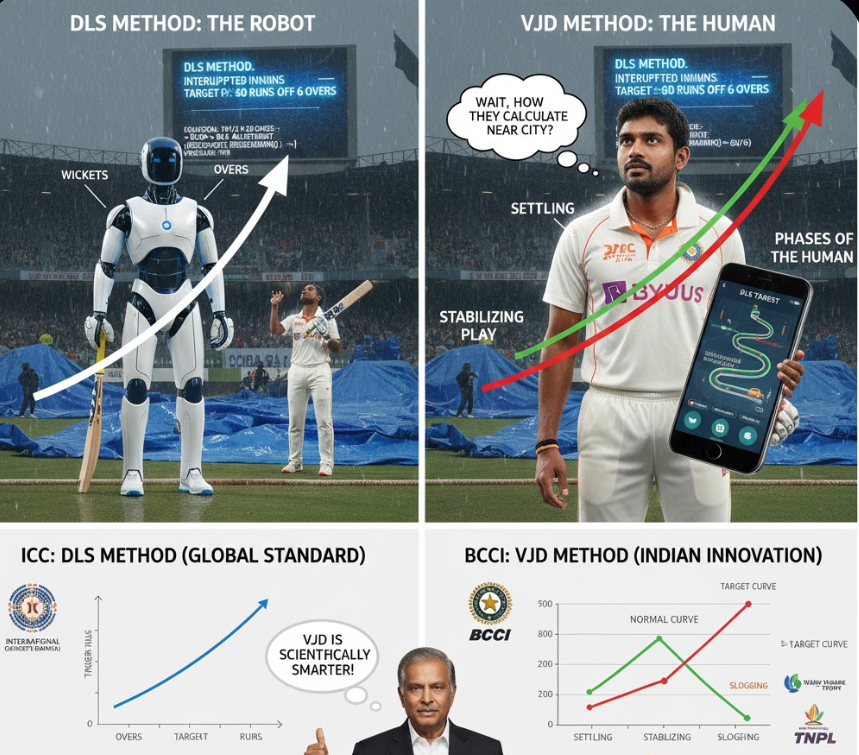
- The Main Difference: DLS uses a single curve, assuming teams accelerate smoothly like a car on a highway. VJD uses two curves (Normal & Target), recognizing that humans play in phases: settling down, stabilizing, and slogging,,.
- Why VJD is “Better” for T20s: DLS is often “sluggish” for high scores. If a team smashes 350 runs, DLS sets a target only slightly higher than if they scored 250. VJD sets a much steeper, harder target, recognizing that chasing 350 is a massive pressure situation.
- The Verdict: The ICC sticks to DLS for global consistency, but the BCCI trusts VJD for domestic cricket because it handles modern scoring trends better. If you are betting on domestic Indian matches, knowing VJD helps you predict steeper targets!
Have you ever stared at a cricket scoreboard after a rain delay and thought, “Wait, the team batting second needs to score MORE runs in FEWER overs? How is that fair?”
We’ve all been there. Usually, we blame the Duckworth-Lewis-Stern (DLS) method, the complex formula the ICC uses for international cricket. But did you know there is an Indian-made alternative that many experts, including the legendary Sunil Gavaskar, believe is actually better and more scientific?
It’s called the VJD Method (V. Jayadevan System).
So, what exactly is it? Why does the BCCI use it for domestic tournaments while the ICC ignores it? And how does it change the betting lines on a rainy day? Let’s break it down simply.
What is the VJD Method?
The VJD Method is a mathematical system used to calculate target scores in rain-interrupted limited-overs matches. It was created by V. Jayadevan, a civil engineer from Kerala, who realized that the existing rain rules were flawed.
While the world sticks to DLS, the VJD method is currently the official system for Indian domestic cricket, including major tournaments like the Vijay Hazare Trophy, Syed Mushtaq Ali Trophy, and the Tamil Nadu Premier League (TNPL).
Read more: What is DLS Method in IPL and Cricket: Deciphering the Rain Rule
The Secret Sauce: “Phases” vs. “Resources”
To understand why VJD might be smarter than DLS, you have to understand how they view a cricket match differently.
DLS looks at “Resources” (The Robot View) DLS treats a cricket innings like a single, smooth curve. It assumes that a team accelerates constantly as the innings progresses. It calculates targets based on two things: wickets remaining and overs remaining.
VJD looks at “Phases” (The Human View) V. Jayadevan understood that humans don’t bat like robots. A cricket innings has distinct “gears” or phases. The VJD method divides an innings into seven specific phases, which can be grouped into three main parts:
- Settling Down & Field Restrictions: (The Powerplay, where scoring is fast).
- Stabilizing: (The Middle Overs, where scoring often slows down to save wickets).
- The Slog: (The Death Overs, where batters go wild).
Because it understands these phases, VJD handles interruptions differently depending on when the rain stops play.
Read more: DLS vs VJD: Is VJD Better Than DLS?
The Big Difference: One Curve vs. Two Curves
This is the technical part, but I’ll keep it simple.
DLS uses a Single Curve. It uses one mathematical curve to adjust scores. It assumes the batting pattern is roughly the same whether you are setting a total or chasing one.
VJD uses Two Curves. This is Jayadevan’s masterstroke. He argues that a team batting first (setting a target) plays differently than a team batting second (chasing a target after rain). Therefore, VJD uses:
- The Normal Curve: To calculate the par score based on the first innings.
- The Target Curve: To set the revised target for the chasing team.
The Takeaway: VJD adjusts the target based on the psychology of the chase, not just the math of the wickets.
Why VJD is Often Considered “Fairer” (Especially for T20s)
If you are betting on a match or analyzing the odds, this is the part that matters most. DLS is often criticized for being “sluggish” in high-scoring games.
The “High Score” Problem When a team posts a massive total (say, 350+ in an ODI), DLS sometimes sets an annoyingly low target for the chasing team if rain hits.
- Real Data Example (20-over chase):
- If Team A scores 250: DLS sets the target at 154. VJD sets it at 142.
- If Team A scores 350: DLS sets the target at 174. VJD sets it at 182.
Did you spot the difference? When the score jumped by 100 runs (from 250 to 350), the DLS target only went up by 20 runs! VJD, however, increased the target by 40 runs. Verdict: VJD recognizes that chasing a massive total is much harder pressure-wise, so it sets a steeper, more realistic target for the chasing team.
Why doesn’t the ICC use it? (The Politics)
If VJD fixes these issues, why do we still see DLS in the World Cup?
- Habit & Standardization: The ICC has used DLS since 1999. Changing a global standard is difficult due to administrative inertia.
- The “Kendix Report”: Years ago, the ICC appointed a statistician named David Kendix to review VJD. He rejected it, but V. Jayadevan claims the report was full of “factual errors” and that he wasn’t given a fair chance to explain.
- Local vs. Global: Some officials felt it would be unfair to use an “Indian” system for international leagues like the IPL where overseas players participate, even though legends like Sunil Gavaskar fought hard for VJD to be used in the IPL.
Summary: DLS vs. VJD Cheat Sheet
| Feature | DLS Method | VJD Method |
| Logic | Uses “Resources” (Wickets/Overs). | Uses “Phases” (Start, Middle, Slog). |
| Curves | Single Curve. | Two Curves (Normal & Target). |
| High Scores | Targets can be too low (Sluggish). | Targets are steeper and harder. |
| Used In | World Cups, IPL, International Cricket. | TNPL, Vijay Hazare, Syed Mushtaq Ali. |
| Best For | Global consistency. | Modern T20s & High Totals. |
The Final Verdict
The VJD Method is basically the “Smart Phone” upgrade to the “Calculator” that is DLS. It understands that cricket has rhythms and phases, and it fixes the weirdly easy targets chasing teams sometimes get in high-scoring T20s.
While the ICC sticks to the old ways, Indian domestic cricket has embraced VJD. So, the next time you are watching the TNPL or Vijay Hazare Trophy on Vipjee and see a revised target, know that you are watching one of the most scientifically advanced rain rules in the world in action!
For more cricket insights, betting tips, and rule explainers, stay tuned to Vipjee.com!
FAQs
1. What is the difference between DLS and VJD?
The main difference is the math they use to set the target. DLS uses a single curve and assumes a team constantly speeds up the longer they bat, like a car on a highway. VJD is smarter because it uses two curves, recognizing that cricket is actually played in phases (starting slow, building up, and then slogging at the end).
2. What is the meaning of VJD in cricket?
VJD stands for V. Jayadevan, the Indian civil engineer who created this system. It is the official rain rule used in Indian domestic cricket (like the Vijay Hazare Trophy and TNPL) to calculate revised targets. Think of it as the “Indian alternative” to DLS that sets targets by looking at the specific phases of a match (start, middle, and slog) rather than just wickets remaining.